
Sevier County Dissolution Of Marriage Proceedings
Sevier County is a south central Utah county named for the Sevier River that runs through the area. Richfield serves as the county seat and is home to the Sixth District Court, which handles dissolution of marriage cases for Sevier County residents. The county's Sevier Valley has long been an agricultural region. Residents seeking to file for dissolution or obtain records from past cases should contact the Sixth District Court clerk in Richfield. Statewide dissolution certificates are available through the Utah Office of Vital Records in Salt Lake City.
Sevier County Quick Facts
Sevier County Sixth District Court Overview
The Sixth Judicial District serves Garfield, Kane, Piute, Sanpete, Sevier, and Wayne counties. The Sixth District Court in Richfield handles all dissolution of marriage petitions filed by Sevier County residents. The courthouse is located in Richfield, which is also the county seat and the largest city in the county.
The Utah Courts directory lists current contact information for the Sixth District Court. The clerk's office can answer questions about what forms to submit, how to serve the other party, and what steps follow after the petition is filed. Calling ahead before your first visit is recommended, as hours and staffing may vary.
For residents in parts of Sevier County that are distant from Richfield, the Utah Courts self-help website offers online resources that reduce the need for multiple in-person trips. Understanding the full process before visiting the courthouse can save significant time.
Sevier County Residency and Filing Requirements
Utah's dissolution statute requires that at least one spouse have lived in Utah for three months before filing. That same spouse must also have lived in Sevier County for three months before the petition can be filed with the Sixth District Court. These requirements are set by Utah Code Title 30, Chapter 3.
Filing a petition before the residency period is satisfied will result in the case being dismissed or held until the requirement is met. The filing fee is approximately three hundred twenty-five dollars. Fee waivers may be available for those with financial hardship; the clerk's office can explain the waiver process.
After the petition is filed and the other spouse is served, a mandatory waiting period applies before the court can enter a final decree. The waiting period is thirty days for cases without minor children. It extends to ninety days when the parties share minor children. These timelines cannot be shortened by agreement of the parties.
Note: Both spouses living apart but within Utah does not automatically satisfy the residency requirements for a specific county; the county where the case is filed must be where at least one spouse has lived for three months.
Grounds for Dissolution in Sevier County
Ten grounds for dissolution are recognized under Utah law. All of them apply in Sevier County cases. Most petitions cite irreconcilable differences. This no-fault ground does not require either party to prove wrongdoing.
Fault grounds are also available. They include adultery, willful desertion lasting at least one year, willful neglect to provide the necessities of life, habitual drunkenness, conviction of a felony, cruel treatment causing bodily injury or great mental distress, incurable insanity, impotency at the time of marriage, and three years of legal separation. Parties who allege fault grounds must be ready to present supporting evidence at a hearing before the judge.
The ground chosen can affect other aspects of the case, particularly how the court views certain financial and property issues. Talking through which ground to cite with a qualified attorney is often a worthwhile step before filing.
Utah Code Governing Sevier County Dissolution Cases
Utah Code Title 30, Chapter 3 is the primary legal framework for all dissolution cases in the state, including those in Sevier County. This chapter addresses the grounds and residency requirements already discussed, as well as property division, support obligations, custody, and the process for entering a final decree.
The image below shows the Utah Courts self-help page, which summarizes key provisions of Utah's dissolution law for residents across all counties.
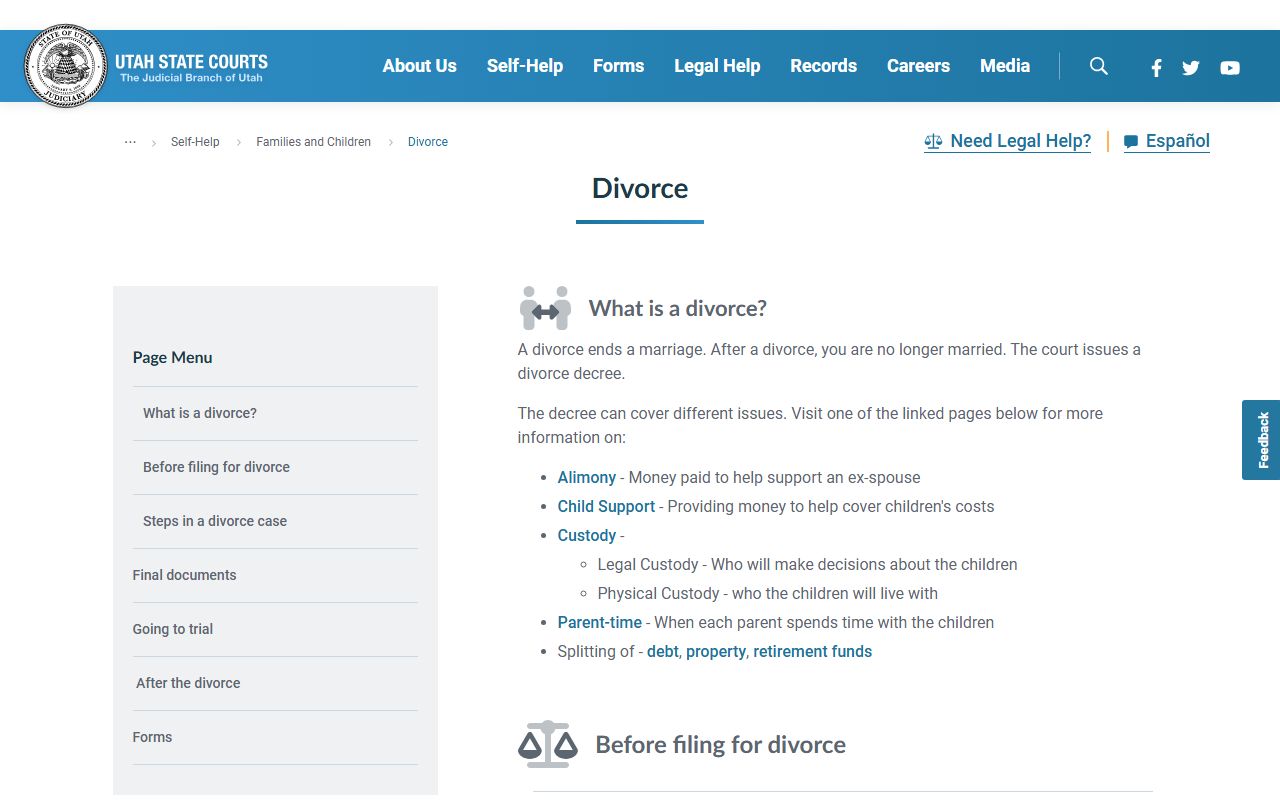
Sevier County residents can use this resource as a starting point for understanding what to expect at each stage of the dissolution process before contacting the court.
Under section 30-3-5, the court divides marital property equitably between the spouses. Equitable distribution does not require an equal fifty-fifty split. The court weighs the length of the marriage, each spouse's economic circumstances, and contributions each party made during the marriage when deciding how to divide assets and debts.
Sevier County Dissolution Court Records Access
Dissolution decrees and court orders from Sevier County cases are accessible to the public. Anyone can request a copy from the Sixth District Court clerk. The clerk charges a per-document fee along with a per-page fee for the pages within each document. Certified copies carry a higher fee than plain copies.
Full dissolution case files have been classified as private since April 1, 2012. Before that date, the entire file was a public record. For cases filed after that date, only the decree and specific orders remain open to public inspection. Parties to the case and their attorneys retain access to the complete file regardless of this general rule.
For older records, the Utah State Archives holds historical dissolution records from Sevier County going back to early statehood and even the territorial period. The Archives can be reached by phone at (801) 531-3800. Staff members can help locate older records and explain the request process.
Vital Records for Sevier County Dissolution
The Utah Office of Vital Records issues dissolution certificates covering all Utah counties, including Sevier. These certificates are official records that confirm a dissolution was granted. They are often needed for purposes such as remarriage, changing a name on a government document, or verifying marital status.
The image below is from the Utah Office of Vital Records website, which processes requests for dissolution certificates from across the state.
Sevier County residents can contact the Vital Records office at (801) 538-6105 or visit 288 North 1460 West, Salt Lake City, UT 84116 to request a dissolution certificate in person or by mail.
The first certified copy is eighteen dollars. Each additional copy of the same record ordered at the same time costs ten dollars. Online ordering may also be available; check the Vital Records website for current options.
Utah State Archives and Sevier County Historical Records
The Utah State Archives in Salt Lake City preserves dissolution records and other government documents from throughout Utah's history. Sevier County records held by the Archives may span from the county's organization through more recent decades before records were digitized by the courts.
Genealogical researchers and those with legal questions about historical property or inheritance matters often find the Archives useful. The Archives staff can search for specific records and advise on what is available and in what format. Some records may be available through the online catalog, while others require a direct request.
Note: Sevier County records from the earliest territorial period may be limited; Archives staff can help identify what records survive and where gaps exist in the historical record.
Self-Help Resources and Legal Aid for Sevier County
Sevier County residents who represent themselves in dissolution cases can use the Utah Courts' online self-help center. The OCAP program guides users through a series of questions and produces the court forms they need for filing. The program charges a modest fee and is designed to be accessible to people without legal training.
Those who cannot afford an attorney may qualify for assistance from Utah Legal Services. This nonprofit provides free civil legal help to income-eligible residents across Utah. Sevier County residents can apply through the organization's website or by calling their intake line.
The Utah State Bar's lawyer referral service is available at (801) 531-9077. This line connects callers with attorneys who handle family law matters. Many attorneys based in larger nearby cities are willing to take cases in Sevier County, particularly when the dissolution is uncontested or the issues are relatively straightforward.
GRAMA and Record Access in Sevier County
Utah's Government Records Access and Management Act gives residents the right to inspect and receive copies of public records held by government agencies. County offices and state executive branch agencies must respond to written records requests within ten business days. Denials must include a written explanation and notice of the appeal process.
Court records follow a different access framework governed by judicial branch rules rather than GRAMA. When seeking dissolution records from the Sixth District Court, the court's own procedures apply. When seeking records from county administrative offices or health-related agencies, GRAMA governs the request.
Understanding which set of rules applies before making a request helps residents direct their inquiry to the right office and use the correct process. Both frameworks ultimately aim to give residents access to the public information they need.
Cities in Sevier County
Sevier County includes Richfield, Salina, Glenwood, Elsinore, Joseph, Monroe, and Sigurd, with Richfield serving as the commercial and government center for the county.
Nearby Counties
Sevier County borders several counties in central and southern Utah, each with dissolution cases handled through their respective district courts.