
Millard County Dissolution Of Marriage Court Records
Millard County occupies a large stretch of west central Utah and holds the distinction of having Fillmore, Utah's original state capital, as its county seat. Named for President Millard Fillmore, the county is served by the Fourth Judicial District, which processes dissolution of marriage cases filed by county residents. This page covers how to access Millard County dissolution records, what state-level offices support that process, and what legal requirements apply from the moment a petition is filed through the entry of a final decree.
Millard County Quick Facts
Fourth District Court Millard County Divorce Cases
The Fourth Judicial District covers Juab, Millard, Utah, and Wasatch counties. Millard County dissolution petitions are filed with the Fourth District Court clerk in Fillmore. The clerk maintains the official case file, issues summons documents, and provides copies of court records to parties and others who meet the access requirements set by Utah court rules.
Millard County is one of Utah's largest counties by land area, but its population is relatively small. The courthouse in Fillmore handles a range of civil and criminal matters in addition to dissolution cases. Confirming the clerk's current hours before visiting is a practical step. The Utah Courts directory lists current contact details for all Fourth District locations, including Fillmore.
All Millard County dissolution cases follow Utah Code Title 30, Chapter 3. The statute is uniform across all Utah counties, though local procedural rules may add specific requirements for filings in the Fourth District.
Residency And Grounds For Dissolution In Millard
Utah law requires at least one spouse to have lived in Utah for three months before a dissolution petition can be filed. This residency requirement applies to Millard County filers just as it does across the entire state. The three-month period measures actual Utah residency, not time in a specific county. A person who recently moved to Fillmore from another Utah county does not need to wait an additional period if total Utah residency already exceeds three months.
Utah recognizes ten grounds for dissolution of marriage under Utah Code Title 30, Chapter 3. Irreconcilable differences is the most commonly cited ground and is accepted by the court without requiring proof of fault. Other grounds include impotency, adultery, desertion, willful neglect, habitual drunkenness, conviction of a felony, and permanent insanity. The filing party lists the ground in the petition, but most uncontested cases proceed on irreconcilable differences alone.
Choosing the correct ground can simplify the process. Most attorneys and self-represented filers in Millard County use irreconcilable differences for this reason.
Millard County Dissolution Records Access Rules
Utah changed its court record access policy for divorce cases effective April 1, 2012. Case files opened after that date are classified as private. The parties to the case, their attorneys of record, and individuals who obtain a court order may view those restricted files. Members of the general public do not have access to the underlying documents in post-2012 cases.
Decrees and court orders are treated differently. They remain public documents regardless of when the case was filed. Anyone can request a copy of a final decree by providing the case number or the names of the parties and the approximate year the decree was entered. The clerk will locate the document and provide a copy for the standard copy fee.
Cases filed before April 1, 2012 follow older access standards. Researchers and genealogists looking for historical Millard County dissolution records from earlier decades may find that those case files are more accessible, either through the Fillmore courthouse or through the Utah State Archives if the records have been transferred.
Note: GRAMA, the Government Records Access and Management Act at Utah Code Title 63G, Chapter 2, governs records requests made to state and local government offices, including courts.
Vital Records For Millard County Dissolution
The Utah Office of Vital Records and Statistics serves all Utah counties from its Salt Lake City location at 288 North 1460 West, Salt Lake City, UT 84116. Millard County residents can request certified copies of dissolution records from this office without traveling to Fillmore. The office phone number is (801) 538-6105, and the website at vitalrecords.utah.gov provides forms and instructions for both in-person and mail requests.
The image below from the Vital Records office page describes the types of records available and the process for obtaining certified copies of dissolution documents statewide.

Certified copies cost eighteen dollars for the first copy and ten dollars for each additional copy ordered at the same time. Mail requests require a completed application, a copy of a government-issued ID, and payment by check or money order. Allow additional time for mail processing, especially during high-volume periods.
Utah State Archives And Millard County Court Files
The Utah State Archives in Salt Lake City holds historical records that have been transferred from county courthouses and state agencies. Some older Millard County dissolution records may reside at the Archives rather than at the Fillmore courthouse. Searching the Archives catalog at archives.utah.gov is a useful first step, especially for records more than a few decades old.
The Archives can be reached by phone at (801) 531-3800. Staff there can confirm whether specific Millard County court series have been transferred and guide you through the request process. The online catalog is searchable by county and record type, which makes it possible to check holdings remotely before making an in-person visit or submitting a written request.
Waiting Periods And Property Rules In Millard County
Utah's mandatory waiting period requires the court to wait thirty days after filing before entering a final decree in cases without minor children. When minor children are involved, the waiting period is ninety days. These timeframes are set by statute and apply equally in Millard County and every other Utah county. Neither the court nor the parties can waive or shorten them.
Property division in Millard County dissolution cases follows the equitable distribution standard established by Utah Code. Equitable distribution does not require a fifty-fifty split. The court considers each spouse's contribution to the marriage, the length of the marriage, each party's earning capacity, and other factors when dividing assets and debts. Both spouses are required to submit financial disclosures so the court has accurate information about the marital estate.
The image below from the Utah Courts self-help page covers the divorce process from initial filing through final decree, including the waiting period rules that apply in Millard County.
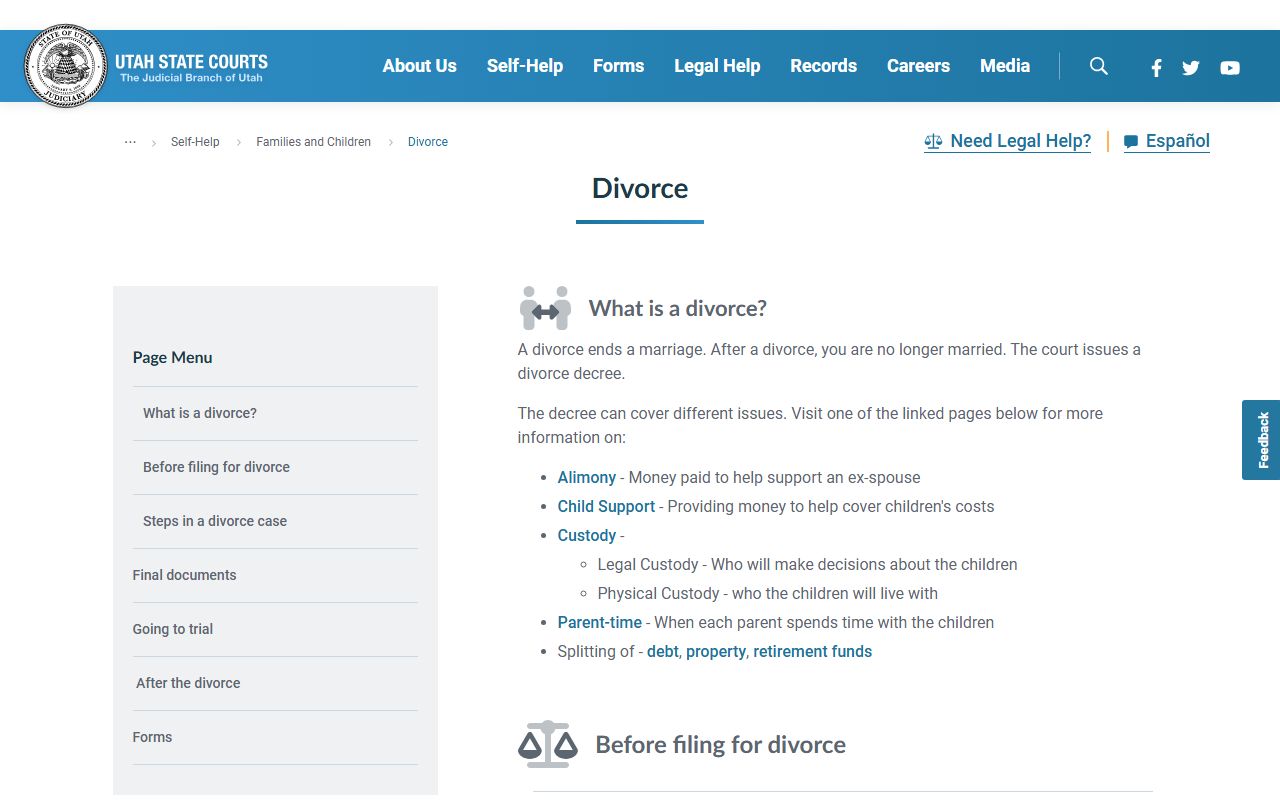
Understanding both the waiting period and the equitable distribution standard helps Millard County residents set realistic expectations about how long a dissolution will take and how property is likely to be treated.
Note: If both spouses reach a full agreement on all issues before the waiting period ends, the court can still enter the decree as soon as the waiting period expires, without a hearing in many uncontested cases.
Self-Help And Legal Services For Millard County
The Utah Courts self-help center at utcourts.gov/howto/divorce provides forms, guides, and procedural explanations for people who represent themselves in dissolution cases. Millard County residents can access these resources online without traveling to Fillmore. The guides cover both contested and uncontested dissolutions and include specific instructions for cases involving children.
Income-eligible Millard County residents may qualify for free civil legal assistance through Utah Legal Services. Cases involving custody, domestic concerns, or disputes over significant assets are situations where professional legal guidance can affect the final outcome. The Utah State Bar referral line at (801) 531-9077 connects callers with licensed attorneys who handle family law matters in Millard County and the Fourth District.
Cities in Millard County
Millard County includes Fillmore, Delta, Hinckley, Holden, Kanosh, Leamington, Lynndyl, Meadow, Oak City, Scipio, and several smaller communities, with Fillmore serving as the county seat and courthouse location.
Nearby Counties
Millard County shares borders with several other west and central Utah counties whose residents file dissolution cases in their own district courts.